Throughout my practice, my work has been inspired and influenced by early feminist teachings. My first experience of this was a course I took at Queens College (CUNY) in 1972. It was called “Women in Art: Contemporary Problems” and was taught by NY artist and longtime Guerrilla Girl Jane Kaufman (1938-2021). Since the only woman artist I was aware of at that time was Georgia O’Keeffe, I thought I should probably sign up. Little did I know I would undergo my first paradigm shift as a result of so much new knowledge about how the world was actually constructed. A feminist lens has continued to inform my work.
As a social practice, my work addresses life’s fundamental questions. I photograph the process of the life and death of plants that serves as a metaphor of our brief existence. Increasingly threatened by encroaching development, plants remind us how fragile our ecosystem is: for example, there is still a very serious concern over the longevity of the honeybees. As an artist working with many media, including photography, printmaking, and installation, I wish to present the natural world’s often hidden beauty in the photos I take. In recording the life cycle of bee-attracting flora, I hope to shed light on our own brief lifespan. The plight of the bees is a call to action that is a social and political action with its roots in feminism. It requires a mindfulness about our place in the universe and the purpose in our lives.
For two decades I worked with honeybee imagery and media. This work was fully documented in a mid-career survey exhibition curated by Scott Canty at the Los Angeles Municipal Art Gallery in 2006-7. Hive Universe: Nancy Macko, 1994-2006 included mixed media installation, traditional and digital archival prints and video. It was accompanied by a catalog with essays by Karin Breuer, Mary-Kay Lombino, Gloria Orenstein, Mary Davis MacNaughton and a foreword by Connie Butler.
In 2009, my focus shifted to examining the flora the bees draw nourishment from and so carefully attend through the process of pollination. Working directly with the camera and a macro lens, I created a body of work called Intimate Spaces, I which I captured their life cycle from bud to bloom to seed. This purely photographic work takes the viewer into a space of light, air and abstracted textures. The images are sensuous and seductive, poignant and tender, sometimes abject and unsettling --challenging you to experience an image that is not easily defined by familiar landmarks or visual cues. In this work I am looking at beauty, aging, intimacy and fragility-- characteristics that are expressed by subjects in nature.
During this time I was also tracking another cycle: the process of memory loss leading to dementia, which my mother was experiencing. In part to acknowledge her journey and in part as a coping mechanism, I created a body of work, Hopes & Dreams: A Visual Memoir, to honor and examine this process. This suite of work reflects the “arc” of her life by using two images of her when she was full of hope and at the threshold of her adult life layered with the flowers in my garden. I think the work provides the viewer with a sense of this decline as well as a poignancy for the loss of one’s memory, while one is still very aware and conscious. Anyone living with or caring for someone with Alzheimer’s or dementia easily relates to this body of work.
For almost ten years I continued to document the flora of native plants that attract bees in different regions of the US and Europe in order to create a lexicon of images that can broaden our awareness of the bees. The bees are a super organism and show us how collaborative work can be done collectively for everyone in the hive. They model to us a better way to survive. The simplest thing everyone can do to help the bees is to plant wildflowers because they provide the bees with the healthy nutrients they need to flourish and survive. My work with botanical specimens underscores my interest in the life cycle, both the bees’ and our own.
The honeybees’ very survival is at risk from pesticides that cause them to lose their memory and thus their way back to the hive. In the exhibition The Fragile Bee, which was first exhibited in 2015 at the Museum of Art and History in Southern California, I look closely at the world of bees, not only to examine their biology and somatic features, but also to study their habitat and highly organized society. The group of works in this show consists of four interconnected multi-disciplinary and multi-media installations: “Botanical Portraits,” photos of bee-attracting flora; “Lore of the Bee Priestess” and “Bee Stories,” two videos in which digital imagery, combined with sound, connects the bees with social and political themes and explores feminine consciousness and archetypes; “Meadow,” a 12 by 36 foot billboard-size mural of a meadow with detailed insets of the native bee-attracting wildflowers; and “Honey Teachings: In the Mother Tongue of the Bees,” an installation consisting of one hundred panels of bee imagery and referential texts, of which some are affixed to the wall. This compelling work is not only meant to inform the public about the plight of the bees but also to raise awareness of our interdependent relationship with them. The Fragile Bee – accompanied by a catalog with essays by Stephen Nowlin, Kathleen Stewart Howe, Carole Ann Klonarides and an introduction by Andi Campognone – traveled nationally from 2018-2025 and was shown in 20 venues across the US.
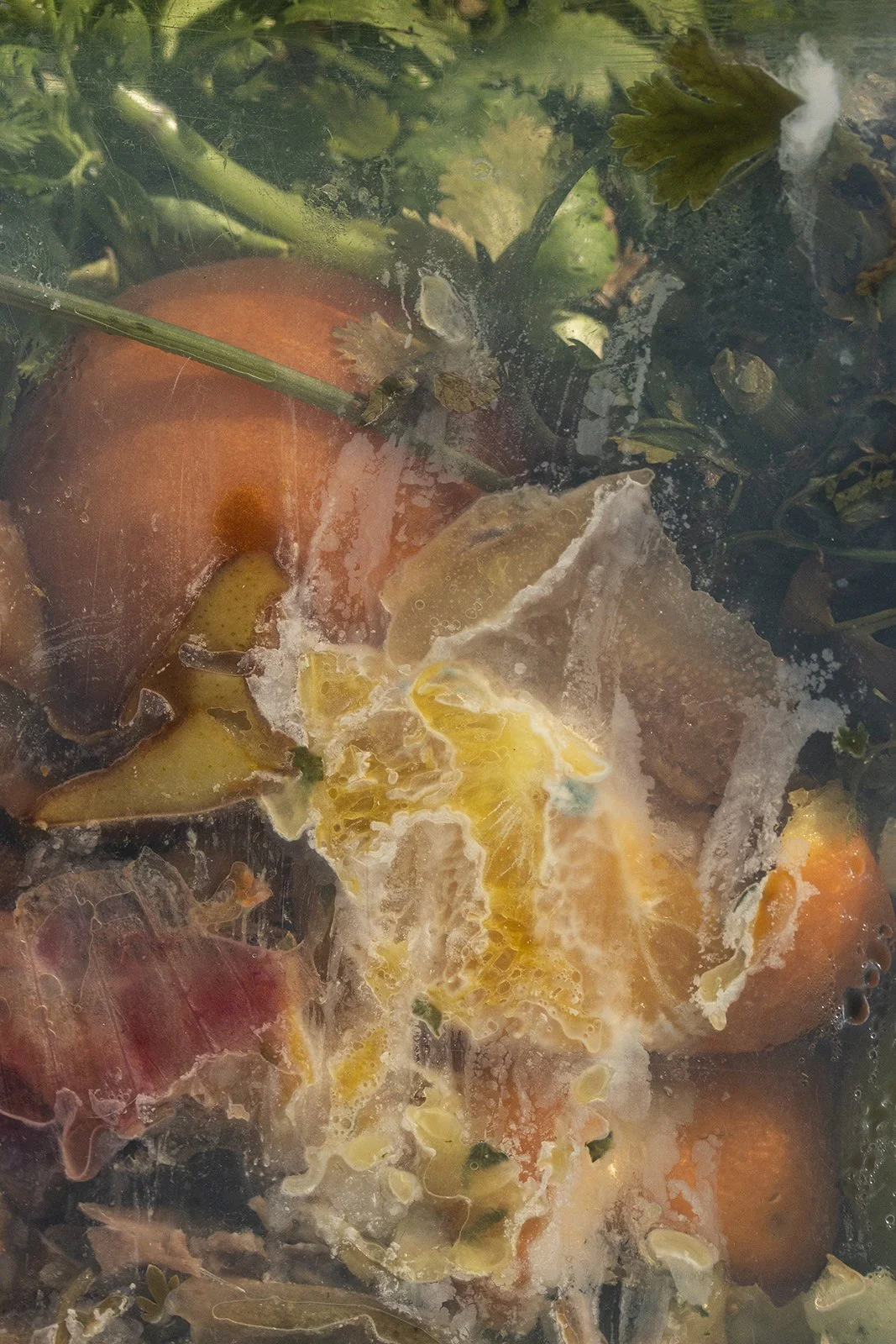
In my most current work, Decompositions, I explore the often-overlooked processes of domestic food usage and recycling through intimate images of my kitchen compost bin. What might initially appear as simple documentation of waste transformation delves into broader global issues, including food justice, safety, and environmental sustainability. While rooted in the domestic sphere, my work speaks to widespread challenges such as inequities in food distribution and the dangers of unregulated agricultural practices. During the isolation of the Covid pandemic, I became captivated by the natural choreography in my kitchen compost bin. Discarded food scraps created striking scenes as they decomposed, with rot and mold forming mysterious, evocative compositions.
In this body of work, I have developed a heightened awareness of non-binary and queer spaces—what Michel Foucault referred to as “heterotopias,” or spaces that exist as ‘other.’ Within these environments, traditional binary dualities are softened. The boundaries between categories become fluid, exemplified by the way solids can permeate into liquids. The rigid distinction of either/or gradually transitions into the inclusivity of both/and, reflecting a movement away from strict classifications. This approach underscores the idea of breaking down established classifications, inviting a more expansive, nuanced understanding of identity and space.
Decompositions is accompanied by a full color catalog with essays by Dr. Linde B. Lehtinen, Philip D. Nathanson Senior Curator of Photography at The Huntington Library, Art Museum, and Botanical Gardens; art historian and Scripps College Professor Emerita Mary MacNaughton and award-winning art critic and author Eleanor Heartney and a foreword by Erin M. Curtis, Gabrielle Jungels-Winkler Director of the Williamson Gallery and curator of the exhibition.
< Back